
Guardia di Finanza
The General Command relies on Sentinet³ to supervise the optical fibre and radio link network that connects its sites.
Project overview
| Customer | Guardia di Finanza, Centro Nazionale di Gestione e Supervisione (CNGS, National Management and Supervision Centre) at the General Command in Rome |
| Objective | Check that the entire network infrastructure works, so that email, web portals and message exchange with the local commands stay operational |
| Technology area | Networking: devices connected via optical fibre and radio links |
| Results | More than 300 devices and 3000 network services checked every minute, faults detected before users notice them, improved resolution times |

A redundant network serving all sites
The Guardia di Finanza is the oldest police force with military status in Italy, a military corps that reports directly to the Minister of Economy and Finance. In addition to the judicial police and public security functions shared with the other police forces, it has special and exclusive tax police powers. It is an integral part of the armed forces of the State, although it does not belong to the Ministry of Defence.
To carry out its work it relies on a complex IT infrastructure. The information systems interact through an optical fibre and radio link network which, thanks to its widespread and redundant coverage, ensures communication between sites and bodies even when a link is down.
The Centro Nazionale di Gestione e Supervisione (CNGS), based at the General Command in Rome, is responsible for checking that the whole network infrastructure works perfectly. Before Sentinet³ was adopted, this task relied on the contact persons at each site: whenever a fault occurred, they alerted headquarters to start troubleshooting.
Active and passive checks, in balance
Today Sentinet³ checks more than 300 devices and 3000 network services every minute. Active and passive checks have been implemented for real-time monitoring of the entire infrastructure.
- Active checks: the central system polls the devices at regular intervals and keeps their status up to date. A fault occurring between two checks, however, is only detected at the next check.
- Passive checks: Sentinet³ listens, and in the event of a fault it is the device itself that reports its change of status.
Careful balancing of the two methods gives the CNGS precise supervision of the whole infrastructure.

Multi-level maps for fibre and radio links
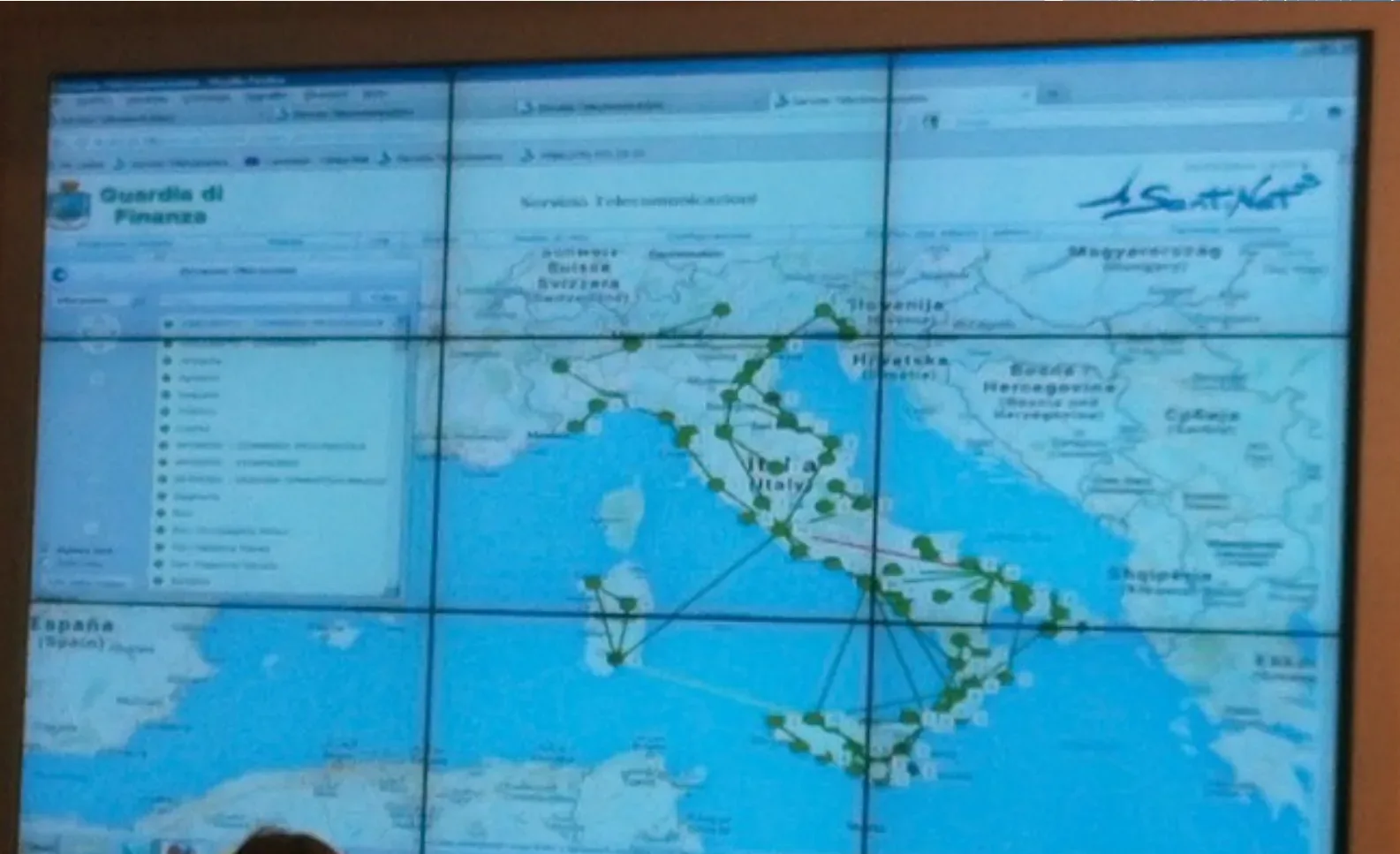
Supervision is supported by multi-level maps that contain both the optical fibre elements and the radio link backbones. The maps give an immediate overview of the links and of the transmission technology associated with each one: a redundancy that keeps the branch sites connected even when one of the two technologies is down.
Problems are seen before users notice them
- Those responsible for the IT infrastructure constantly monitor the status of the devices and become aware of faults before the users of the services.
- Problem resolution times have visibly improved.
- Whenever a fault occurs, the contact persons are informed immediately by an alerting system over a redundant channel, email and SMS, which triggers the troubleshooting procedures in real time.
Sentinet³ features in this project
More success stories
Want to see Sentinet³ on your infrastructure?
Tell us about your environment: sites, technologies, critical services. We will show you how Core and Infinity can work on your case.